

Why Is It Essential To Feed Your Dog Well Before Hunting?
Nov 29, 2022
Why is it essential to feed your dog well before hunting?

A hound can travel nearly 50 kilometers behind wild boars while some pointers are able to cover 100 kilometers in their day! About a hundred kilometres, the distance separating Paris from Orléans. Behind these impressive figures hides a real necessity: an appropriate diet.
The dangers of undernourishment
When talking at the hunting lodge, we often hear: “I never feed my dog before the hunt, it makes him angry. The aggressiveness is not measurable, so we can hardly refute this argument. Thinking about my girlfriend's general mood when she's hungry, I think that's probably even true. But this is a very bad calculation. We explain why.
Imagine. You have just lost a bet with Gégé, your hunting colleague. You must leave Orleans and reach Paris, all at a run. What would you eat before taking on this challenge? You would be looking for a high energy yet digestible diet. A suitable diet.
You need to adopt this logic for your dog if you want him to be successful, healthy, and ward off injuries. Indeed, nutritional deficiencies will quickly cause injuries to your furry friend. An underfed dog will lack protein, essential for muscle health. Running out of protein increases your dog's risk of muscle tears . A dog that goes hunting with nothing in its stomach will not have the carbohydrates and fats giving it the energy it needs to flush out wild boars, pheasants and other game. From then on, he will show signs of early fatigue . A dog with little or no food before the hunt is also more likely to be injured by game .. Deprived of resources, his body damaged after hours of racing, no longer allows him to be as alert in the face of a load of wild boar.
The solution ? An adapted diet throughout the hunting season!
About 70% of a dog's energy expenditure is for metabolic maintenance. That is to say, at complete rest, 70% of nutrient intake goes to basic functions such as respiration, thermoregulation or digestion. It is therefore necessary to play with the remaining 30%.
Some veterinarians recommend increasing the rations by 20% during the hunting season. It is a solution that allows dogs to obtain the proteins, fats and minerals essential to the achievement of their sporting achievements. But it's not the best. First of all, your dog may not have the appetite to eat 20% more kibble. Then, if this diet is effective between two hunting days, it is counterproductive on hunting days. Just as you can't imagine running from Orléans to Paris with an empty stomach, you can't imagine achieving this sporting feat after abusing cheese fondue.
The best solution is to provide your dog with a diet high in protein and fat during hunting season, while keeping the same ration . It is considered that a kibble calibrated for hunting must contain approximately 30% protein and 20% fat. It is an important marker but to qualify. Quality kibbles, concocted with ingredients clearly displayed and chosen for their nutritional benefits, may have lower levels of protein and lower fat while meeting the needs of dogs during hunting season. Quite simply because the ingredients used are more assimilable than those used in a low-cost kibble, which will inflate its rates with cereals and animal meal of poor quality.
It is therefore essential to carefully read the composition of your dog's kibble. If you want to know if your croquettes are of good or bad quality, a very simple little trick. Manufacturers of poor quality products often use very vague terms for their ingredients: “meat and animal by-products”, “animal meal”, etc. Behind these words hides a reality that is not only unappetizing but also deceptive, insofar as not all nutrients can be assimilated.
What about hunting days?
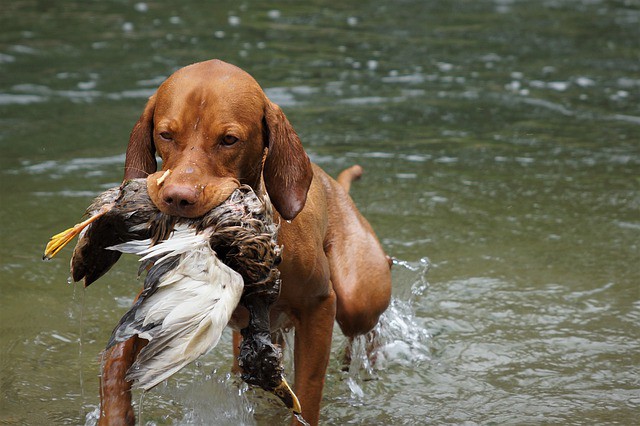
As explained above, your dog must eat before going hunting. It is here that the quality of the kibble will have all its importance because it is necessary to considerably reduce the ration and to give it at least two hours before the effort. A quarter of the usual serving is generally considered the ideal pre-hunt snack. So that the croquettes remain as short as possible in the stomach, some do not hesitate to moisten them slightly.
Rich, good quality kibble will satisfy your dog's nutritional needs, even in small quantities. Obviously, this is not the case for a kibble low in protein and fat or of poor quality...
